


We’ve been told a story that human society evolved from primitive barter to superior modern money.
That linear story flattens thousands of years of value exchanged through reciprocity, mutual aid, and gift economies. Systems that nourished people and ecological relationships.
Modern (fiat) money and its associated systems have a valuable role to play but it has become a de-stabalising force in our culture, one that is at the root of all our planetary challenges today. Redesigning money is a core pathway to a more regenerative, Light Forest World.
Today, we’re joined by Stephen DeMeulenaere, who has spent over 35 years helping communities design financial tools that strengthen local economies, support small businesses, and build resilience in times of crisis. Stephen lives in Bali and is the co-author (with Scott Morris) of a recent book Pathways to Regeneration: Hope and Resilience Through Anticipatory Design
In this walk through the forest, Stephen takes us down many paths:
The history of money, economy, and anthropology, to explain how our current system is on the verge of collapse.
A range of approaches from his book, drawing on leading thinkers, such as Kate Raworth and John Fullerton, and EF Schumacher, to redesign currency and economies.
His first-hand experience working with communities in Thailand and Indonesia designing community currencies in the late 90s
A sharp assessment of the potential of blockchain to enable decentralised forms of currencies, and the practical challenges working with crypto space and the technology and rooting them in local communities.
His life’s focus has been on using local currencies, digital payments, and regenerative economic models to help communities thrive—whether in rural villages, urban neighborhoods, or entire regions. He has worked with community currencies, emergency currencies, and credit unions during the Asian Monetary Crisis in Japan, Hong Kong, Thailand, Indonesia, and East Timor after their independence. He led Indonesia’s first non-profit stablecoin and continues to bridge the worlds of community currencies and blockchain technology, collaborating with commons-centric communities to ground crypto in real-world regeneration.chain technology, collaborating with commons-centric communities, to ground crypto in real world regeneration.
I met Stephen during my crypto sojourn at Funding the Commons Taipei in 2023 and then again at Devcon 7 in Bangkok in 2024. I’m delighted to bring him to the podcast!
🌳☀️🧧 Support the Podcast
The podcast is a self-funded labor of love in the spirit of learning & service. All content is open by default with no paywall. If Light Forest sparks something meaningful for you, in the spirit of reciprocity, I’d be deeply grateful for any support.
The simple act of sharing this with 1 friend that you think would resonate goes a long way to keep me sharing and grow this forest. You can also choose a free or paid subscription via Substack or a one-time tip of any amount.
In This Conversation
The false stories underlying our systems
The myth of Money’s linear Evolution
For thousands of years, mainstream economics has taught us that humans progressed from primitive barter systems to modern money through natural evolution. Stephen calls this a myth. Highlighting the diverse reciprocal exchange systems that existed throughout human history—until empires hijacked them. We can learn from Ancient wisdom about cooperation and mutual aid in redesigning regenerative financial systems.
Beyond Survival of the Fittest
Cooperation between species, especially in harsh environments, is actually more likely to ensure survival than competition. While competition plays a role within species, cooperation is essential for collective survival during times of crisis. This was put forth by Peter Kropotkin’s book “Mutual Aid” (written over 120 years ago) which presented an alternative to Darwin’s theory of evolution that emphasized competition.
Both the myth of competitive evolution and the myth of money’s linear progress serve the same extractive paradigm.
For thousands of years, mainstream economics has taught us that humans progressed from primitive barter systems to modern money through natural evolution. Stephen calls this a myth. Highlighting the diverse reciprocal exchange systems that existed throughout human history—until empires hijacked them. We can learn from Ancient wisdom about cooperation and mutual aid in redesigning regenerative financial systems.
GDP Growth
GDP measures monetary activity, not wellbeing, and perversely rewards destruction while ignoring care, reciprocity, and community resilience.
“GDP fails to account for many important contributions to the economy that aren’t monetized. The women’s work, what they call it, or volunteer work, or caring for children and the elderly. Anything we do for free, you could say the gift economy, favors that we do for each other, anything that isn’t monetized isn’t forming a part of those calculations.”
Community currencies in Thailand and Indonesia during the ‘97 Asian Financial crises.
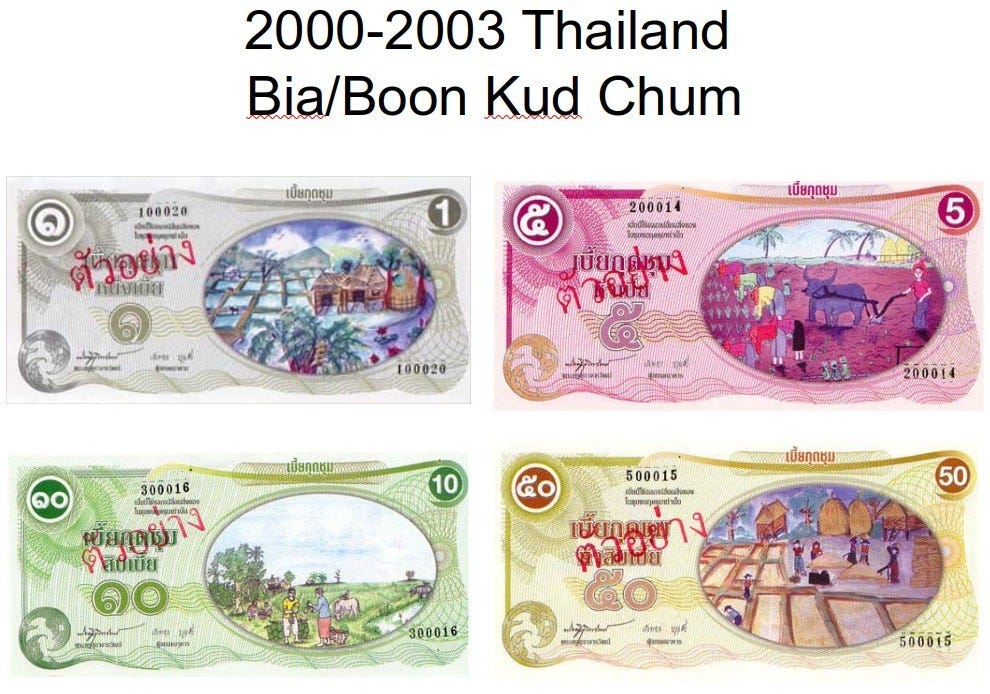
During the Asian financial crisis, national currencies were “vacuumed out” of rural communities. People had food, factories, and skills—but no medium of exchange. Stephen was on the ground as part of a volunteer program from Canada and shares firsthand experiences helping communities in Thailand and Indonesia create mutual credit systems that enabled local exchange when national currencies failed, supporting thousands of families through crisis.
Anticipatory Design: A Non-Prescriptive Framework
Drawing from Buckminster Fuller and E.F. Schumacher, Stephen introduces “anticipatory design”—a framework that empowers local communities to find their own solutions rather than imposing top-down prescriptions. This approach brings together diverse economic thinkers from Peter Kropotkin’s mutual aid theory to Kate Raworth’s donut economics, and Buddhist Economics, creating a toolkit for pathways to regeneration.
Currency as a Mosaic: Yin and Yang Economics
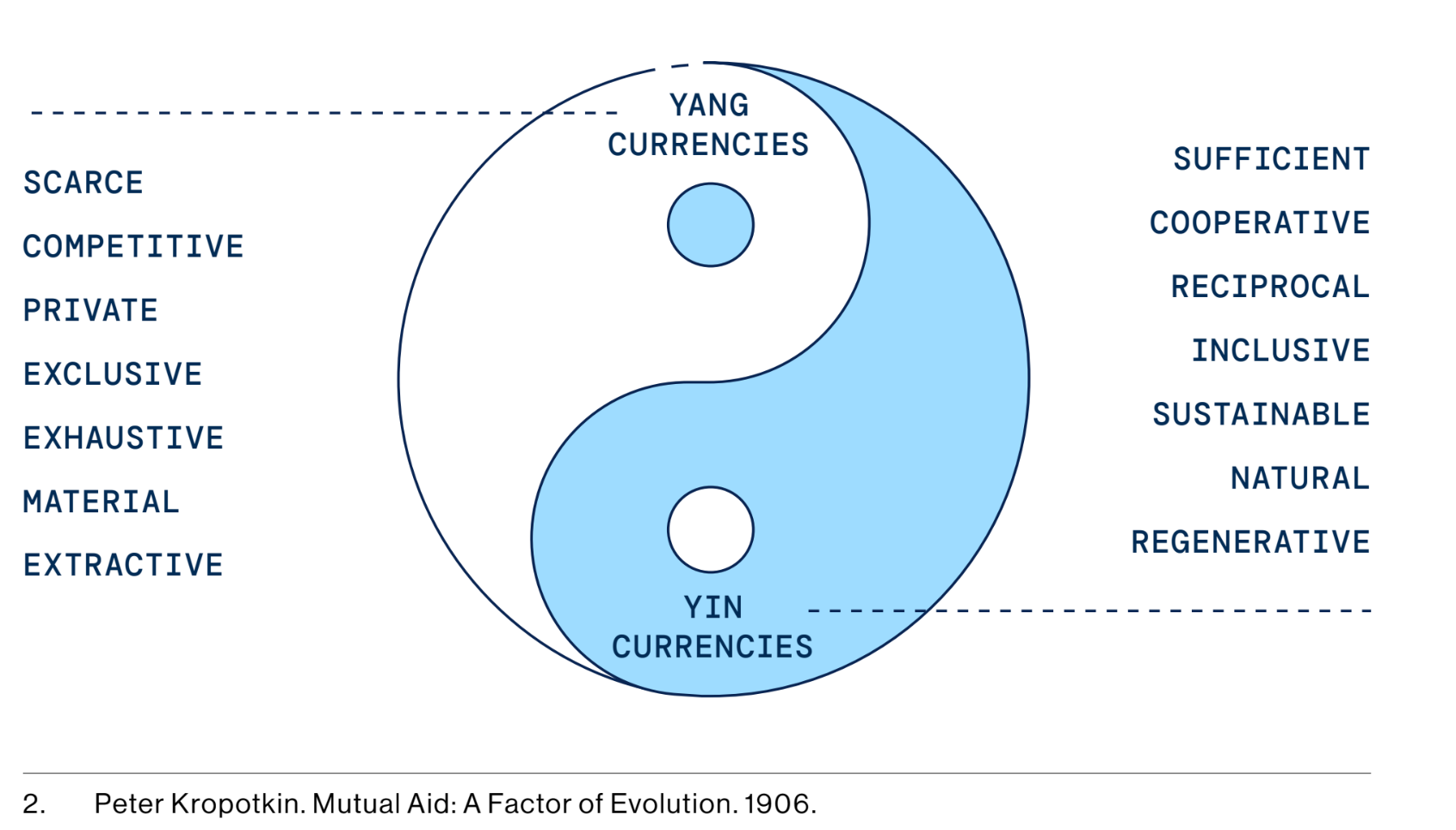
Mainstream currencies like US dollars and euros are “competitive currencies” placed on the yang (masculine) side of the duality. But there’s also the yin (feminine) side—currencies based on reciprocation, gift exchange, and time-based systems that don’t need to represent fixed material wealth.
“Bernard Lietaer...talked about that a lot, about the importance of designing currencies to fulfill specific purposes rather than trying to use one currency to try and fulfill all purposes.”
Blockchain potential and false dawns
Community currencies struggle to scale especially when it crosses 150 people (Dunbar’s number). In the past we only existed locally and within small villages. Scale was not a problem. Today we need to be able to design for entire cities, for strangers to transact.
Blockchains, like Ethereum and Cosmos, allow us to do this in decentralised fashion with community ownership. His book goes into detail on this potential.
Stephen laments on how the space has gone astray from its Cypher punk roots, dominated by speculation, trading, and too much of an insular focus on tech, and not working closely enough with local communities on the ground it hopes to help.
Key Future Global Flashpoints
de-dollarisation & decenteralisation at the global level
As ASEAN implements QR-based payment systems bypassing the US dollar and BRICS builds alternatives, we’re witnessing simultaneous decentralization at the national level. Stephen sees this as steps in the direction of localization and reclaiming sovereignty that happens at many levels.
“that makes me optimistic for the future because then there’s like a cascading series of transitions towards decentralization, which I think is the fundamental nature of humans..to express our freedom.”
Climate Crisis as Catalyst for Local Economics
Governments will not be able to afford to spend their way through climate disasters. Stephen sees this as the inflection point that could cascade into broader economic transformation, as communities realize they must organize their own resilience.
that’s going to change the landscape for local economies and governance significantly in the years and decades ahead.”
Taking Action: Start Small, Build Trust
Stephen’s advice is practical: gather your closest friends and start conversations about resilience. Map what you’re already exchanging informally. Identify local needs and capacities. Use simple ledgers or databases before reaching for complex blockchain solutions. Read widely, self-educate, and remember that technology serves community, not the reverse.
Projects and Initiatives Mentioned
Commons Hub (Austria) - Co-housing and community wealth building
Traditional Dream Factory (Portugal) - Place-based eco-community
Rifi (Sicily) - Community development project
Zuzalu - Pop-up city experiment
Ethereum Localism - Movement to connect blockchain with local economies
Funding the Commons - Public goods funding initiative
WIR Bank (Switzerland) - Long-running mutual credit system (nearly 100 years old)
Credit Commons Network - Developed by Matthew Slater for fungible local currencies
Cycles - Invoice clearing project on Cosmos blockchain (Slovenia)
Sarafu Network / Grassroots Economics - Commitment pooling in Kenya
Community Wealth Building Project (Amsterdam)
Global Eco-Village Network - Asia/Southeast Asia communities
Taman Patanu (Bali) - Eco-village east of Ubud
Books Referenced
Debt: The First 5,000 Years by David Graeber
The Dawn of Everything by David Graeber and David Wengrow
Donut Economics by Kate Raworth
The Future of Money by Bernard Lietaer
Rethinking Money by Bernard Lietaer
Mutual Aid: A Factor of Evolution by Peter Kropotkin
Small is Beautiful by E.F. Schumacher
Metaphors We Live By
Books by Douglas Rushkoff on cypherpunk philosophy
Works by Jim Bendel
Works by Michel Bauwens
Connect with Stephen
Telegram Private Group: Collaborative Finance Official Group
Book: Pathways to Regeneration: Hope and Resilience Through Anticipatory Design (with Scott Morris)
Chapters
02:16 Introduction to Stephen DeMeulenaere
04:39 The Problematic Design of Economic Systems
08:49 Extractive Economies and GDP Critique
14:37 Anticipatory Design Framework
19:10 Understanding Currency and Community Currencies
33:49 Practical Applications of Community Currencies
36:41 Designing Local Economies: Lessons from Indonesia
39:34 The Role of Credit Unions in Community Economies
40:40 Rethinking Money: From Barter to Relationships
44:09 Crisis as a Catalyst for Monetary Innovation
45:00 Community Resilience in Times of Crisis
47:32 Exploring Forms of Capital in Local Communities
49:29 Blockchain and Community Currencies: A New Frontier
52:38 Bridging Community Currencies and Blockchain
01:04:31 The Future of Community Currencies and Blockchain Integration
01:07:56 Building Trust in Governance
01:11:13 The Role of Blockchain in Community Governance
01:15:24 Local Communities and Collaborative Economies
01:20:03 Future Pathways and Financial Crises
01:30:32 Taking Action and Building Resilience


