


VOTE NOW: MADE MASAK for KELIAN, BANJAR WARAS.
At this point, Banjar Waras does not exist, and Made Masak has expressed no political ambitions; a few days earlier, she was simply taking us out to forage for lunch. This is not a campaign and I should probably explain better.
A few days earlier, around fifteen of us had spent the morning with Made Masak, walking around a farm, stopping every few meters because she had spotted something edible. A common garden weed, tumpang danu, makes the best salad. Daun katuk, another ordinary species traditionally known to support breastfeeding mothers, turns out to give dishes a wonderful umami depth. Andong makes the prettiest color in tea; raw cacao fruit flesh is as refreshing as lychee. Shoots, ferns, flowers, and herbs were introduced faster than our fascination could keep up with.


At lunchtime, pieces of the landscape appeared on our plates. Made cooked according to what was available. She put together what everyone had gathered, divided the tasks, and along the way decided what the meal might become. The meal was extraordinary: fresh, complex, and alive. Ridiculously good.
In the evening, somebody said, RESISTANCE STARTS FROM THE KITCHEN. Of course, I thought. It had already started there, on our first plate which planted the seed. Over the next three days, that feeling kept expanding. As Emerging Earth unfolded, the boundaries between things felt less and less solid, including the boundary between ourselves and everything around us.
Emerging Earth was a three-day residency by Light Forest World that brought traditional Balinese knowledge into conversation with futures thinking. The questions were deliberately large: what can inherited knowledge tell us about land, food, healing, ancestral connection, and technology; what futures might emerge for ourselves and Bali;
and how might we become better ancestors? The residency took place at Saridevi Ecolodge in Jatiluwih from 21 to 23 August 2026.
Visit the website for more
Much of what we were talking about already sits in plain sight in Bali: rice fields, offerings, banjar, ceremonies that close roads, Subak, Tri Hita Karana. Yet there is a palpable feeling that the symbolism is increasingly devoid of meaning in 2026 Bali. Trash clogged rivers, disappearing rice fields and forests, tourist economies, fast foods, and growing frictions between those that consider themselves locals and guests.
The closer we looked, the more their edges began to blur into one another: food into land, land into water, water into community, and eventually ourselves into the larger web around us.
Part of what made those connections possible was the particular constellation of people gathered.
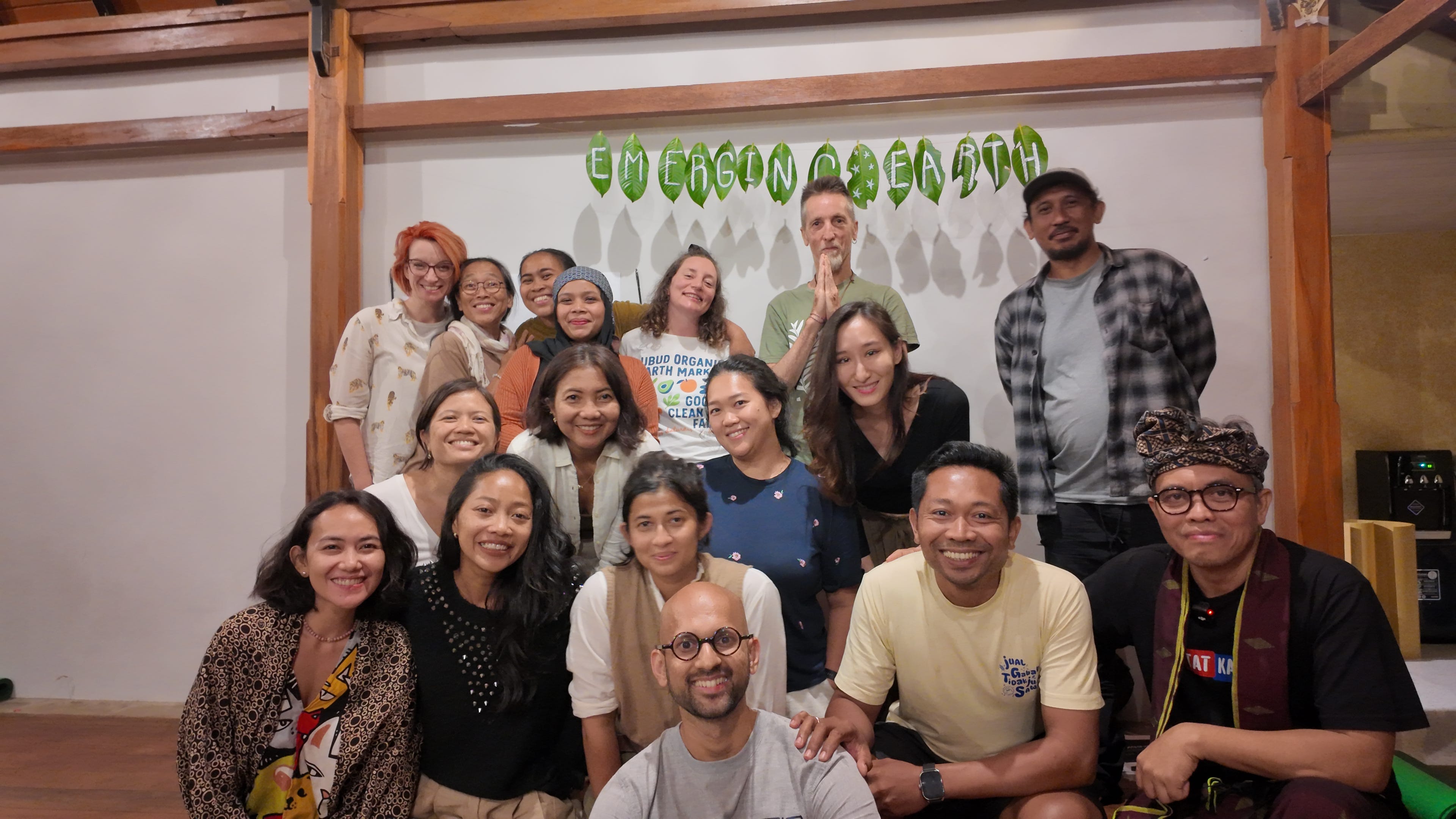
We had people from diverse worlds: art, technology, farming, space, and climate researchers. More than half came from Bali and other parts of Indonesia, the rest from wider Asia, Australia, Middle East and America. We shared an awareness that every challenge we face today requires a deeper cultural shift rooted in relationship with land. Bali was the site to embark on this journey. To reconnect with the traditional knowledge of this island, and invite it to guide our futures.


Made is an apt person to begin with.
Her work sits somewhere between cooking, foraging, community education and cultural preservation; she describes food as a way of carrying stories, healing, culture, and nature together. During her session, the relationship was immediately tangible. The plant became lunch and the landscape entered the body.
Sugi Lanus joined us that afternoon, and my notes from this session are mildly unhinged with arrows going everywhere. Guru Sugi comes from a Brahmin family in North Bali and grew up surrounded by religious practice, manuscripts and stories of his grandfather’s samadhi. Sitting together, we moved through an enormous amount of territory: food, land use, water, plastic, agriculture, Balinese spatial philosophy, the Green Revolution, reincarnation, language, collective karma, and the way traditional knowledge itself gets translated, simplified and sometimes emptied out.
Subak was one example. Calling Subak an irrigation system is not exactly wrong. Water is distributed through it; rice fields depend on it. But if water has to be shared, then people have to negotiate. What happens upstream affects somebody downstream. Farmers have to coordinate with other farmers whose needs will not always be identical to theirs. Planting, water, temples, rituals and collective obligations sit in the same landscape. Perhaps a social system is a better descriptor.
The following day, Putu Bawa Usadi uttered a sentence I wrote down immediately:
The paddy field is not secular.
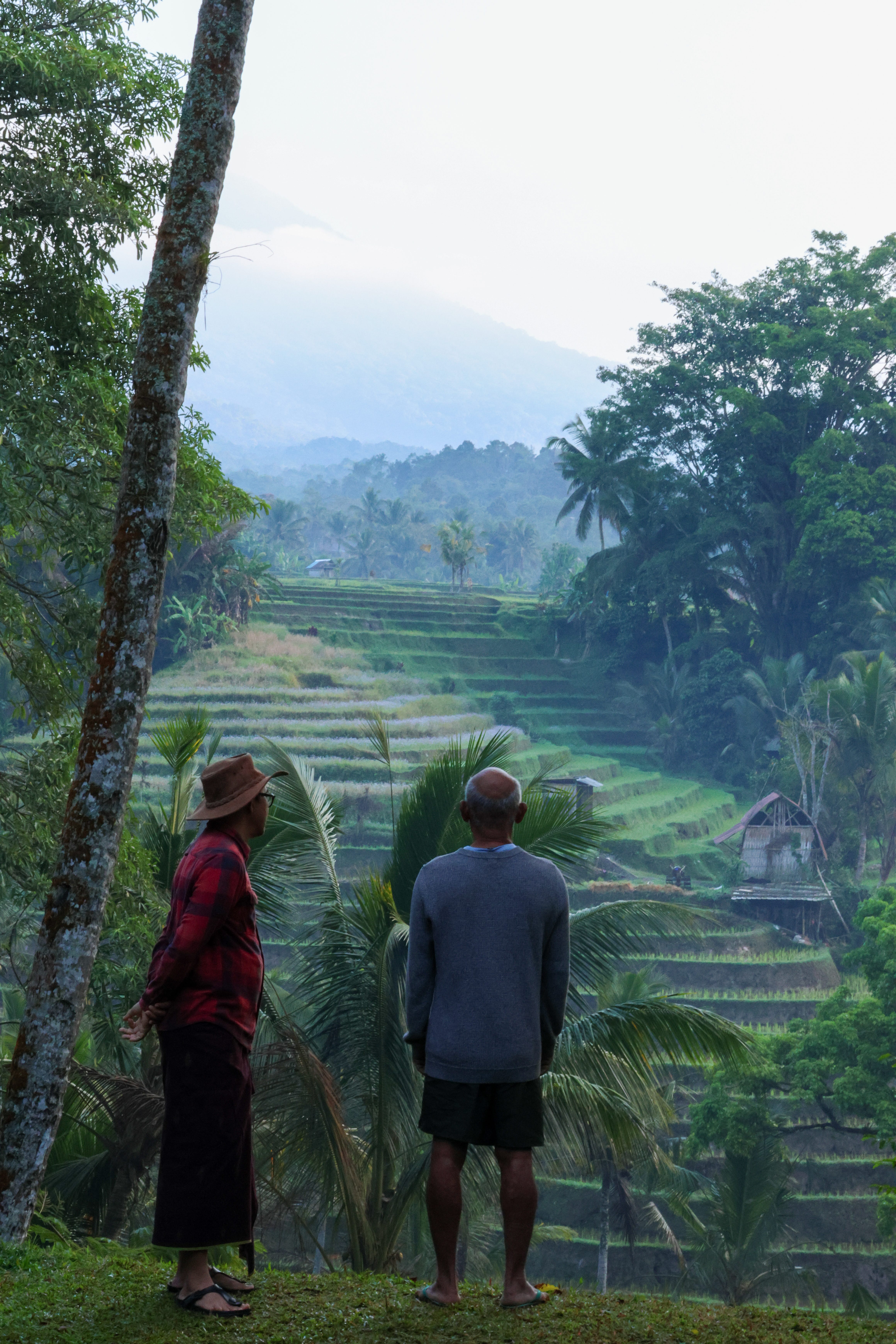
A paddy field receives and passes on water. It supports livelihoods. Other species inhabit it. Ritual obligations run through it. Knowledge about planting and seasons lives in it. It carries the work of people who lived before us and affects generations after us. Agriculture, ecology, economy, culture and spirituality all at once.
A kitchen was not only a kitchen either. Sugi spoke about resistance beginning there because what enters a kitchen reaches much further than the room itself.
What we cook affects what we buy. What we buy affects what can be sold. What can be sold affects what farmers grow. What farmers grow affects which seeds remain useful, which tastes remain familiar, which plants continue to have a place in the landscape and which forms of knowledge are still worth passing to another generation.
Follow a meal backward for long enough and eventually you reach a field. Follow the field and you reach water. And water brought us to Etha Widiyanto.
Etha had come to Bali more than three decades earlier looking, as she put it, for a rhythm. I loved that word. Around her were circular diagrams of biodynamics connecting Balinese agricultural calendars, celestial movements, planting, harvesting.
She and Putu told us about Lake Batur through stories of water and exchange, and about what happens when a relationship with water is reduced to the question of what can be extracted from it. Etha also spoke about Nusa Penida, where earlier generations built cisterns because life on an island without permanent rivers required people to catch and hold what water came. When water became easier to buy and transport, some old cisterns eventually became septic tanks.


Convenience can be a genuine improvement in life. But a structure designed around scarcity had also contained knowledge and reverence that disappeared along with its practical needs. For Penida, the water is there but the remembering of water did not necessarily travel with it.
A similar question surfaced around land and food:
what is the difference between taking what a living system produces and consuming the system that makes production possible? Sell rice, not the rice field. Take the fruit, not the tree. Use water without destroying the source that replenishes it.
It sounds almost embarrassingly obvious when reduced to a sentence. In practice, much of modern economic life becomes complicated precisely because the source is often worth more dead, subdivided, extracted or converted than it is alive and productive.
That is a question for another piece. But once it appeared, I started seeing versions of it everywhere. The butterfly would make the same complaint later.
Before we got there, though, Etha and Putu gave us another word that became important to the shape of the three days: Nyama Braya.
One way they described it was through the idea of nyama (kin): a way of making room for others within the circle of who belongs. They spoke too about segilik seguluk sabayantaka. A phrase often written on Balinese customary law - a foundational philosophy an idea of living together as one community moving, with plenty of room inside it for compromise.
Shared water is not a meaningful achievement if everybody happens to want exactly the same amount. Its social intelligence becomes visible when there is not enough, when upstream and downstream interests differ, when one person’s action changes another person’s conditions. These exact geopolitical scenarios exist across Asia, between and within countries, manifesting most recently in the flash floods in Nepal. Our modern day nation state design lacks the social intelligence necessary to govern water. A clear example of the need for indigenous knowledge based reimagination of how we govern water.
On the opening night Guru Sugi opened the portal for us into Tri Angga. Balinese cosmology rooted in Lontar Manuscripts Hasta Kosala-Kosali and Hasta Bhum.
Tri Hita Karana was already deeply familiar to me, perhaps too familiar. Sugi had spent the previous day complicating the polished version that appears so easily in institutional, tourism, and sustainability language, including the ways it has been simplified and used as greenwashing. There is history sitting behind those three familiar words. Tri Angga landed differently for me because Putu brought it immediately into the body: head, body, feet; thinking, feeling, doing. It gave me something much smaller to ask of myself: do the things I understand, the things I feel, and the things I actually do have anything to do with one another?
Knowledge of what is good should travel. Head to heart. Heart to action.
What struck me about Tri Angga is that it translated spatially into the material realm. A logic that includes a space for farming (nista) and the living settlement (Madya) with the kitchen as the bridge. This example becomes especially valuable in the conversations of economic or political systems.
Spirituality can easily become abstracted to high concept words and aspirational values, with no consensus ways of review. Today they are used as slogans in policy document or in a speech, an ironically become justification to continue behaviour that is clearly in violation of the values. This rings true not just in Bali but nearly every country in Asia. In India, the state officially uses the Sanskrit phrase Vasudhaiva Kutumbakam One Earth One Future One Family. Slogans that are so clearly disconnected from the reality of how governance actually happens. The moment Tri Angga's physical structure is broken, such as replacing home gardens completely with imported cement, the living roots of the philosophy are killed.
By the second night, the circle de-centered. What would happen if, for a while, we stepped outside the human point of view altogether?
We received an invitation to the Nature Wisdom Council for Bali.
We were invited to choose another being whose soul we would represent, make a mask, and arrive beside the fire prepared to embody and speak as them.


I chose Butterfly, I was joined by another butterfly. As well as a firefly, a Kintamani dog, a giant ficus, the Ayung River, the collective spirit of the trees, a worm, a forest guardian, a rice field, a Javan kingfisher, the spirit of the flowers, a dragonfly, the water of the island, and a garden.
I think humans are generally fond of butterflies. We photograph them. We make jewellery shaped like them. We turn metamorphosis into metaphors for our own lives. Seeing a butterfly still gives me a small hit of joy. Butterfly, however, had an issue with our branding.
“You think I am beautiful, but you starve my babies.” Caterpillars are less universally adored, and they are considerably fussier about what they eat. Remove their host plants and eventually there is no butterfly. The same for the firefly, the worm, all suffering similar fates.
The complaint was funny enough to say around a fire while wearing a handmade mask. Then it followed me out. We love the butterfly. What sustains the caterpillar? We love the rice terrace. What sustains the farmer? We love Balinese food. What sustains the landscape that grows its ingredients? We love ceremony. What sustains the communities, materials and obligations that allow it to remain lived rather than merely displayed?
How often do we become attached to the beautiful expression of something while paying much less attention to the conditions underneath it?
The Nature Wisdom Council took Nyama Braya somewhere I had not expected. Who is our neighbour? Our kin? Another person, certainly. But what about the beings who will live with what we do to a piece of land? Species that cannot attend a planning meeting or appeal a land permit but remain deeply implicated in whatever decision humans make.
Banaspati Raja, associated in the stories we heard with the spirit of the forest, had already entered the discussion. Putu spoke about an older gravity attached to changing a forest into agricultural land. Transformation was not treated as though nothing had been there before us.
Someone later wrote: ASK PERMISSION FROM THE LAND.
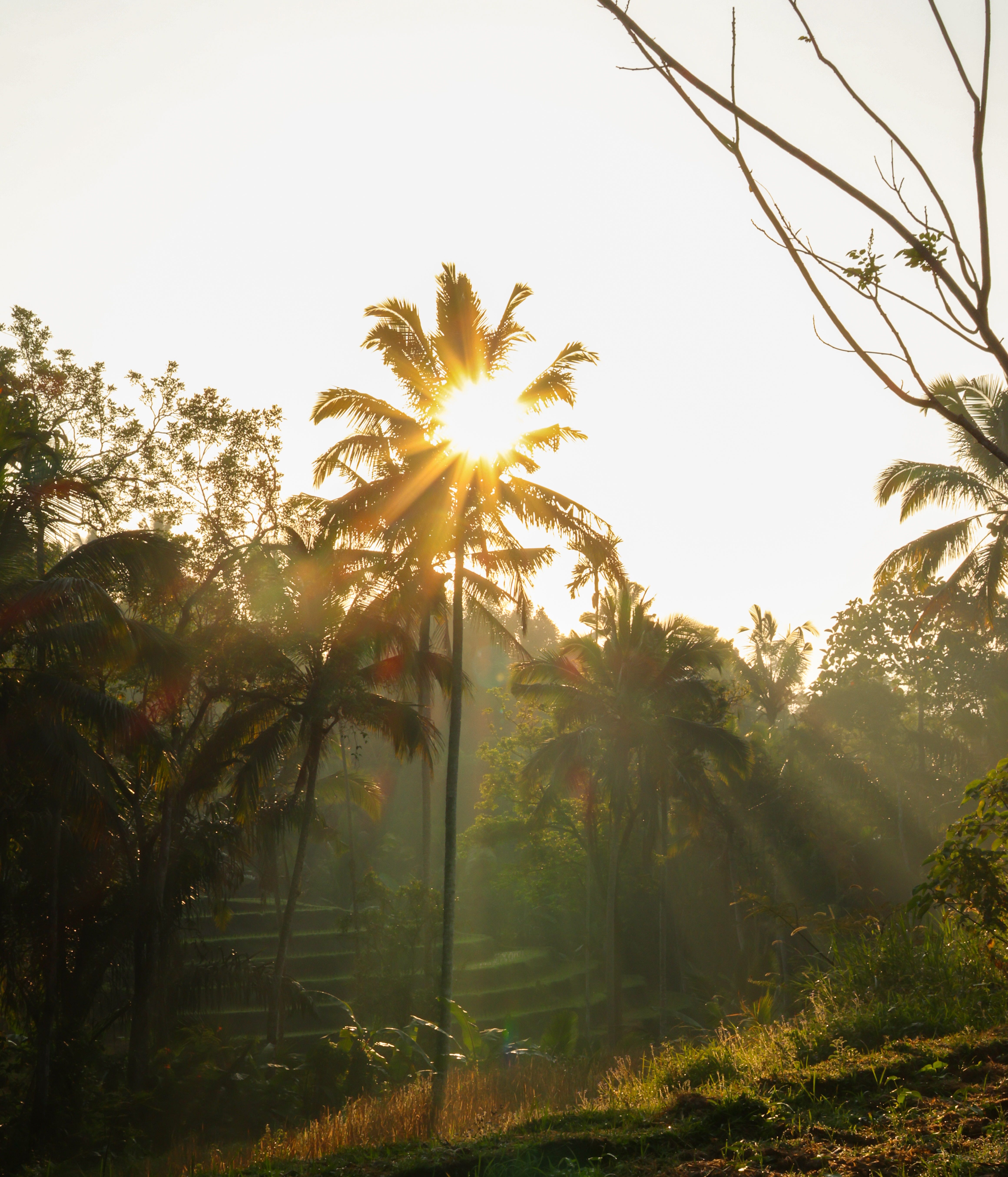
I like that sentence partly because it can meet people at different depths. For one person it may be a spiritual instruction. For another, it may simply mean pausing long enough before changing a place to ask what is already happening there. Where does its water go? What grows here? Who depends on it? What disappears when this changes? What has already been invested in making this place what it is?
Asking permission may begin with something as simple as slowing down enough to notice that taking was never the only available action. From land and other beings, the circle then stretched through time.
We are all ancestors.
It is obvious once someone says it. We call ancestors the people behind us because we are standing here looking backward. From the perspective of someone living a hundred years from now, we already occupy the past.
Karmapala: action, result. I had understood cause and consequence mostly as something moving forward: you sow, then later you reap. Putu complicated that sense of time. The relationship can be circular. What we enjoy today may be the result of care and decisions made long before us, while some of the comfort we enjoy now may actually be borrowing against the future. We are receiving consequences and creating them at the same time.
Etha put the same idea into soil: leave the next generation better soil than the soil you received. That is perhaps one of the clearest descriptions of inheritance I have heard. Something reaches you. You live with it. You change it. Something leaves your hands.
This was also where the residency avoided becoming an argument for returning to some idealized Bali before modernity. The people we call ancestors were not living in “the past.” They were living in their own present, responding to the technologies, constraints, ecologies and possibilities available to them. Perhaps the interesting task is to inherit attentiveness: to understand what came before us well enough to know what should continue, what needs to evolve, and what no longer deserves to be carried.
The giant Ficus reminded us of a time when our ancestors did commune with the non-human world. “For there was a time when man used to talk to us, but he forgot”, and “we will be here with open hearts when he remembers” The giant Ficus reminded us of the compassion and patience that trees hold for us, despite all the deforestation we have caused. While today can feel like forever and eternal, it wasn’t always this way and will not always be so. Our ancestors gave more than they took. We are living this inheritance. Like many trust fund generations, we’ve only been trained how to spend, how to take, not how to give and add. Remembering how our ancestors did natural accounting deserves chapters in our biology and mathematics classes.
Only after two days receiving these transmissions, of slowing down, of rooting in the land, were we asked to imagine the future. By then we had accumulated an abundance of Seeds and Soil for a rooted future.
Rooted Futures
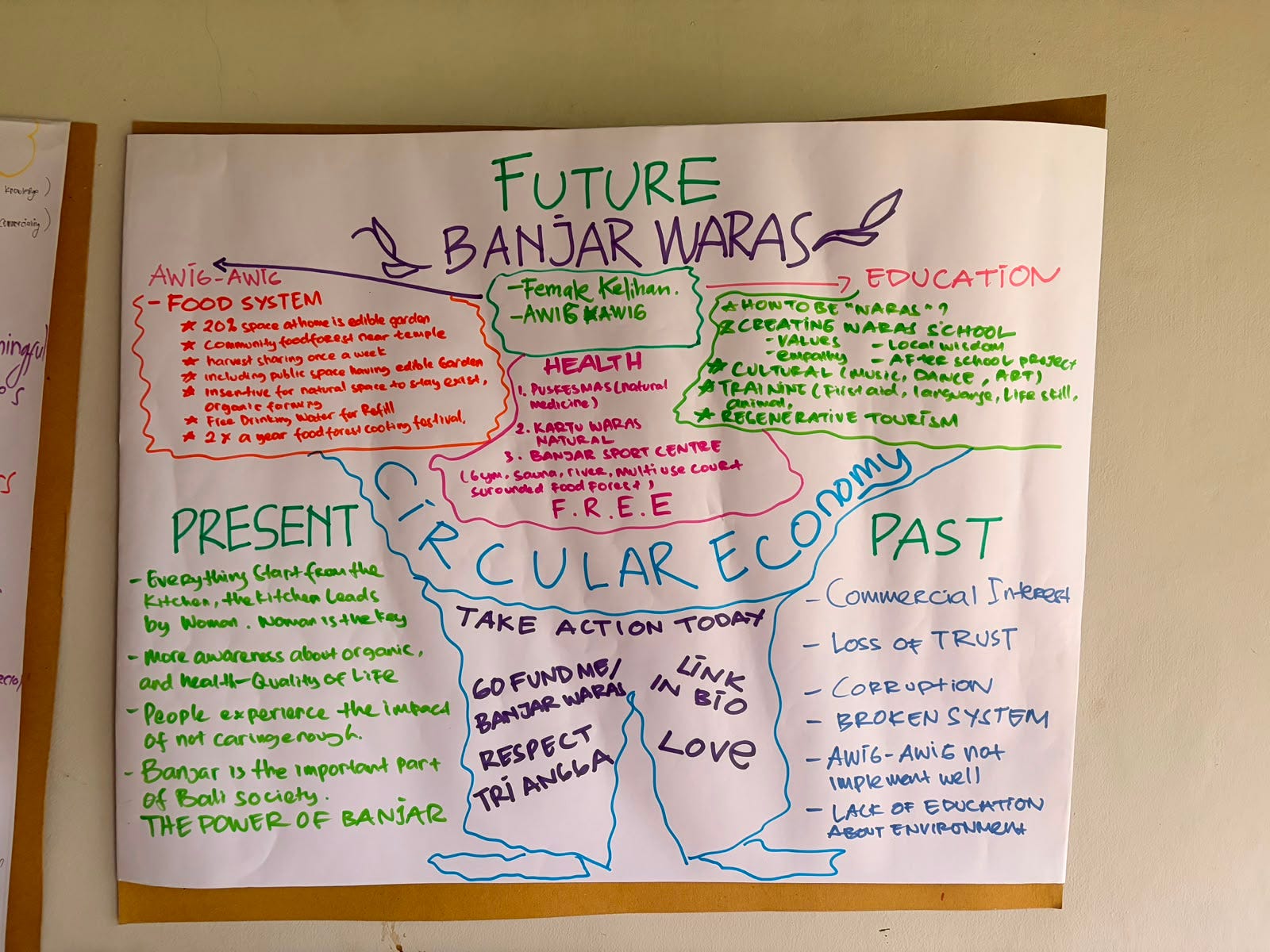
There were many reasons of the ‘present’ that brought us all to Emerging Earth: land conversion, pollution, plastic, commercial pressure, centralized power, corruption, loss of trust, environmental degradation, cultural knowledge becoming something performed rather than lived. On Day Three, a futures exercise invited us to ask what future we imagined for ourselves and Bali, what in the present was pushing us there, and what was holding us back.
The residency was intentionally designed to bring Balinese knowledge into contact with futures practice. Because imagination is a vital function of meaning making and of reality creation that has been conditioned out of us.
At Emerging Earth, we practise “rooted futures”.
The practises of grounding in land, eating wild and forgotten foods, holding our sense of ‘self’ more lightly, asking for permission from the land. This activates an intelligence within us that is beyond the intellect or conditioned mind. To expand beyond our everyday frame of “normal” or “probable” into emergent possibilities.
One group staged a tourist arriving and asking for Balinese food only to find locals offering avocado wraps and quinoa. A global food crisis eventually squeezes the local family financially. It leads them to realise how it had traded its own food security (via its land) in exchange for money that was diminishing in value. They were not the only such family. It took the crises for them to band together, led by the Banjar to reclaim food sovereignty.
At another point, we became nine goddesses scattered around Bali: a scientist, a chef, an engineer and other forms of knowledge, with Goddess Nusantara at the center. A natural catastrophe displaced people. Land became contested. Conflict followed. Eventually the goddesses realized none of them knew enough alone. They had to collaborate.
My group created Banjar Waras. An “All is Well” Banjar.
Banjar is the smallest and most active traditional neighborhood community unit in Balinese society, operating just below the official government village.
It began with circular economy and the kitchen. Then it expanded to dedicated space for edible gardens. Community land around temples could become a food forest. There could be shared harvests, public edible gardens, incentives for organic farming, free water refill and regular food festivals. Health and education entered next: community access to natural medicine and foraging as part of the school curriculum. The school we imagined taught empathy and local knowledge alongside practical skills, first aid, languages, music, dance, ways of participating in a community. And somewhere in the middle of this, our future banjar acquired a woman as kelian.
Eventually somebody decided Made Masak should take the job, which is how our whiteboard ended up promising to vote for her as the first kelian of Banjar Waras 2050. It was funny. It was also surprisingly coherent.
Made, who had begun the residency by showing us what could feed us around the place where we already stood, had somehow become the imaginary leader of a community organized around food, health, reciprocity, education and living land. It was also apt because Made was the attractor that brought many of us together.
And perhaps the most interesting thing about Banjar Waras was how little of it felt futuristic in the ways pop culture resorts to. Yep, no AI-enabled ceremonial metaverse. Mostly we wanted good food, clean water, healthy bodies, living soil, useful knowledge, shared spaces, communities that could negotiate with one another, and enough imagination to change what no longer worked. What we might consider ‘Rooted futures’.
Looking at everything together, I did not feel that we had discovered one grand secret philosophy capable of explaining Bali or the world. We followed food far enough to reach land, land far enough to reach water, and water far enough to reach the people who needed to share it, in the present and into the future.
On our final afternoon, we held an Ask & Offers Market. People offered what they could carry forward: skills, introductions, companionship, knowledge, time. Dev offered an essay. Alvita offered a policy paper.
Those two offers eventually found each other. The policy paper can wait. I have questions I want to take much more seriously there, particularly around land: what if proposals to change land use had to account for more than the economic value easiest to calculate? What if water, food production, biodiversity, cultural function, community value and what remains possible for future generations were also made legible? What if the promises attached to a development were clear enough that ordinary people could participate in monitoring whether they were kept?
But the stranger effect of Jatiluwih has been happening much closer to home. Near where I live, passionfruit sometimes falls to the ground. I used to walk past it. Now I pick it up. I have also caught myself behaving differently around insects, giving them a fraction more consideration before the automatic swat or removal. I think differently about what owning land could mean. I notice edible things more often. Small changes, almost embarrassingly small compared with the scale of the questions we spent three days discussing. For me, when I departed Bali after the residency, it felt like I was leaving a home. Leaving behind friends I wanted to spend more time with. Questions I wanted to explore. Since then I find myself saying Jangan Jangan to myself. All signs seem to point to food forest. This felt like Saudara.
Toward the very end of the residency, after we had spent days accumulating words, sunya and monobrata appeared on the board: connection with nature beyond language, silence, going beyond words. There was something almost funny about that too. We had spent three days furiously writing vocabulary only to arrive at the possibility that the point was eventually to stop needing the vocabulary.
Maybe words are scaffolding. Useful while we are learning to see something. Less important once the relationship becomes ordinary enough to inhabit.
Made did not need to explain interconnectedness while picking a leaf. Foraging requires discernment. You need to know what you are looking at. What can be eaten. What needs preparation. What is ready. What should be left where it is. What can be taken without destroying the possibility of finding it again. That discernment is inherited knowledge from people who have looked before you.
Everywhere, there are things we pass daily without asking much about them. Water arriving from somewhere. Food grown by someone. Neighbors carrying knowledge we do not have. Plants we stopped recognizing.
The task is not to return to the past. It is to forage from it.
Banjar Waras is no longer just an idea but a community rooting in Bali. Subscribed to Light Forest World on Substack and IG to stay in the loop.