
Imagination that doesn't start in the mind
What futures work looks like when imagination begins in the body — and why it changes how we need to gather (and an invitation to one in Bali)

Emerging Earth Bali is 4–day residency in August for Earth Focussed Professionals working through traditional Balinese knowledge and Futures. Learn more and apply here: https://www.emergingearth.world/
Most imagination work is a mental exercise.
Scenario building, Foresight, Speculative fiction. Over the past decade working in the tech policy space at Digital Asia Hub, we brought imagination and speculation into our workshops, and it helped people emote and come alive to understanding they hadn't conceived before. I bring this into Light Forest futures workshops too.
Today, from education to work, climate to politics, there is a growing movement for transformative change. To deeply question and reimagine existing cultures and systems from the ground-up. To do this we need to re-look at what imagination is.
What gets called imagination, is largely very mental i.e. analytical mind driven (with some exception to approaches that work in dance and improv). However creative the outcomes may appear to be, by being mind driven, it is limited by our culture and inherited ways of understanding the world.
What if we understood imagination, at its deepest layer, is not a mental activity — but a state of being?
One that is embodied: present, in tune with the body and its emotions. Relational: in deep connection with the people around us and the land beneath our feet.
Where the work is not just about ideas that can be documented and shared, but also about expressing a state of being that becomes a ripple in the field.

The work of Imagineering
Futures Studies scholar Marcus Bussey has spent decades writing on intuition, imagination, and transformative change. He argues that imagination, at its deepest, is more verb than tool — not something we deploy but something we practise and inhabit:
“imagination ceases to simply be a tool for thinking and generating ideas about better futures. It actually becomes a verb. That’s why I use the term imagineering, like engineering.”1
Bussey highlights a key limitation about imagination: we cannot imagine something that does not exist in our worldview or frameworks for sense making. Imagination relies entirely on the cultural context within which we exist.
This is significant when we’re playing the game of transformative change.
As 21st century creatures, we’ve grown up in a culture organised around stories of scarcity, competition2, and control over nature, and educated in systems designed to produce people optimised for nation building and corporate work3. The primacy of reason and logic — the idea that analytical thinking is the only form of knowing — sits so deep, especially in our academia and adjacent institutions who lead the futures imagination work. We generate '“imaginative” outputs, but we generate them from within the same mental framework we’re trying to transcend.
And beneath the cultural layer is something heavier and less visible. Trauma, from our childhood and ancestral — the accumulated weight of colonisation, world wars, famine — sits unconsciously in our bodies, running our lives as backseat driver. The latest science around epigenetics is beginning to map what spiritual traditions have long known: what our ancestors survived lives on in us.
One of my podcast guests, Qammaruzaman — a peace educator described how he came to recognise much later in life that his own drive to do good in the world was rooted in childhood trauma. The real work has to start within first. As he put it speaking about peace education: you cannot give what you don’t have.
This is the bind. We want to imagine new worlds. But the imagination we’re using has been shaped by the world we want to move beyond. Books, podcasts, workshops and conferences— they help. But they remain in the domain of the analytical mind. They do not touch the deeper conditioning that lives in the body. And this work does not show us how we may be embodying the very patterns of the world we are so determined to change. As Phoebe Tickell, the founder of Moral Imaginations warns, by running imagination onto the current programming, you just just get more innovation for the dominant culture4.

imagination as a state of being that transcends cultural conditioning
So in order to imagine transformative change, pathways that genuinely transcend our present-day systems, we have to move beyond mental-led imagination of worlds outside, and start within.
Intuition, Bussey writes, opens the mind to relational possibilities that were previously denied to it by cultural conditioning5. A state where we are not just thinking about the future that we want to inhabit but we are sensing and feeling into it in this present moment.
Philosopher and neuroscientist Iain McGilchrist puts the neurological case plainly. In a recent conversation with Nate Hagens he explains:
“The left hemisphere closes down to certainty. The right hemisphere opens up to possibility… Imagination requires spaciousness, silence, emptiness — the exact opposite of what our culture offers.”6
In Daoist cosmology, this is “Real knowledge真智”, non-discursive immediate knowing, that makes up a human being’s intelligence, equally alongside our intellectual knowledge. Only by bringing both forms of knowing can we exercise agency and free will7.
At the Light Forest Emerging Earth residency last year, we experienced this form of imagination.
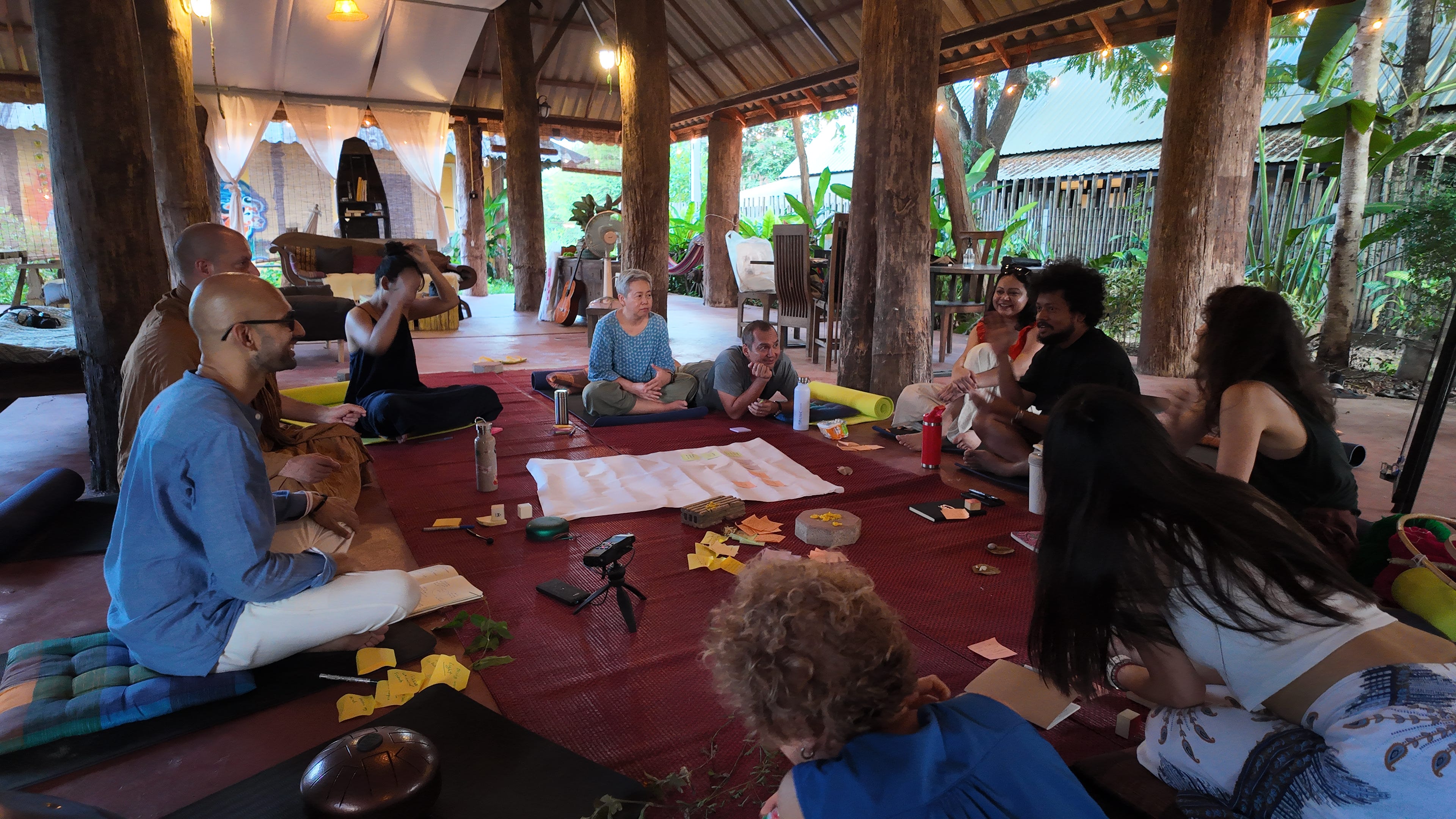
We spent a day in silence at a Buddhist temple, walked through the surrounding forest, and moved through intentional practices to release emotion baggage and bring ourselves into relationship with living world. We entered the futures imagination session in a different state of being.
People in the circle observed how imagination was not really about thinking or images of the future but a sense of living it and embodying the values we seek in the future, now. That imagination allowed us to exercise a form of intelligence that our logical mind could not access.
Our conversation continued to Climate Change. How the disconnection between humans and nature — which sits at the root of the ecological crisis — does not actually exist. It exists because we collectively imagine we are separated, we make it real: in our institutions, our economies, our cities. The work is to re-imagine. But it cannot be done mentally. It has to be done through embodiment — when we move from thinking about the earth to thinking and sensing as the earth. When the grief and joy of the earth becomes part of our lived experience.
Emerging Earth Residencies
This is the work we’re exploring in the Emerging Earth residencies.
Creating conditions for people to be still. To disconnect from screens and connect with land, and move through the fears, grief, and conditioning that constrain who we think we are, before turning to futures work of imagination itself.
We use the Nature Wisdom Council, a speculative role-playing practice, to invite participants to get in the role of non-human life8. We use Futures’ method Causal Layered Analysis (CLA) as structure that allows us to channel imagination into a map that can offer pathways to futures. As Bussey writes, these tools become balancers and sensemaking devices that play to both our intellectual and logical mind. They become a map for charting intuitive and emergent possibilities9.
They allow the formless a path to turn into form.
Dr Ora-orn's (creator of Nature Wisdom Council) research shows what becomes possible when this dimension is present: people move beyond rigid analytical structures, bring compassion and empathy into the process, and leave feeling more interconnected and more hopeful. The outputs are profoundly different — not because better techniques were used, but because different people showed up to use them.10
Doing the ‘inner’ work to uncover our deep layers of conditioning is a life-long journey and practise.
The time has come for these practises to spread from the private space of our homes and temples into all of society, into the workplace, classrooms, and policy councils. The old world order which only respected rational mind and the masculine is withering away, and people are yearning for other ways of knowing and relating to help us sensemake.
When we experience in community, we build shared language and resonance that is often very difficult to explain but unmistakably real. We feel into interconnection, wholeness, and care, and from this space we act and create.
Join us in Bali this August
Emerging Earth will be held at the Batukaru Biodynamic coffee estate. We will connect with traditional wisdom holders and and go on this Futures imagineering journey from thinking about the earth to thinking as the earth.
If this is calling to you, I’d love to walk this part of the forest with you, please drop me a note.
And because its hard not to write about imagination and not have John Lennon playing in my head the whole time :)

https://en.wikipedia.org/wiki/Deschooling_Society
Tickell, Phoebe. “Moral Courage and Imagination Activism.” Interview by Matthew Monahan. The Regeneration Will Be Funded, Ma Earth, 2 June 2024. YouTube, timestamp ~39:54.
Bussey, M. (2015) Intuition, Rationality and Imagination. Journal of Futures Studies, 20(1): 139-148. https://jfsdigital.org/wp-content/uploads/2015/09/S8.pdf
McGilchrist, Iain. "The Counterintuitive Need to Slow Down and Find Spaciousness." Interview by Nate Hagens. The Great Simplification, EP217, 22 April 2026. YouTube


Bussey, M. (2015) ibid
Poocharoen, O. Foresight, Public Policy, and Spirituality: Bridging Inner and Outer Worlds, Dubai Futures Forum 2025